

Kids and Grieving: Find the Right Words
 For children, the loss of a grandparent or other family can be hard to comprehend. Breaking the news of someone’s death to a child in the right way is paramount for their long-term emotional and mental well-being.
Regardless of age, you must use concrete language the child will understand. “If you say ‘we lost grandma’ or ‘dad went to heaven,’ children, especially young ones, will try to find the loved one or ask to go to heaven to visit,” says Lane Pease Hendricks, MS and director of education and innovative programs for Kate’s Club. “As emotional as it can be, you have to explain it simply and directly.”
Hendricks suggests saying things like: Everything that is living will one day die. Once someone dies, he isn’t hungry or thirsty anymore. She can’t talk on the phone or come visit us.
The location also matters. “Offer a quiet, calm place,” says Hendricks. “Don’t do it at a park or somewhere the child could run away. If it’s at the hospital, you can bring in a chaplain or social worker to help you.”
In the case of a tragedy, keep the lines of communication open and ask your child questions. Hendricks suggests asking, “What have you heard?” This gives you a chance to ensure your child has the right information and helps you see where they are in the process,” says Hendricks.
When someone in the family is ill, you can give kids options for how involved they want to be before someone dies. “Give your child the opportunity to spend time with the person who is dying if they want it,” says Hendricks. If the person who is sick is able, kids often enjoy these moments. Let your child choose what they want to do — draw a picture, ask the person some questions, watch TV or read a book.
Don’t give younger kids too much warning if someone is gravely ill because they do not have a concept of time. Hedricks does recommend keeping teens updated with disease or cancer diagnoses. “They value being kept in the loop,” she says. “They feel more trusted, and it allows them to make choices for themselves on how much time to spend with the person and to process things.”
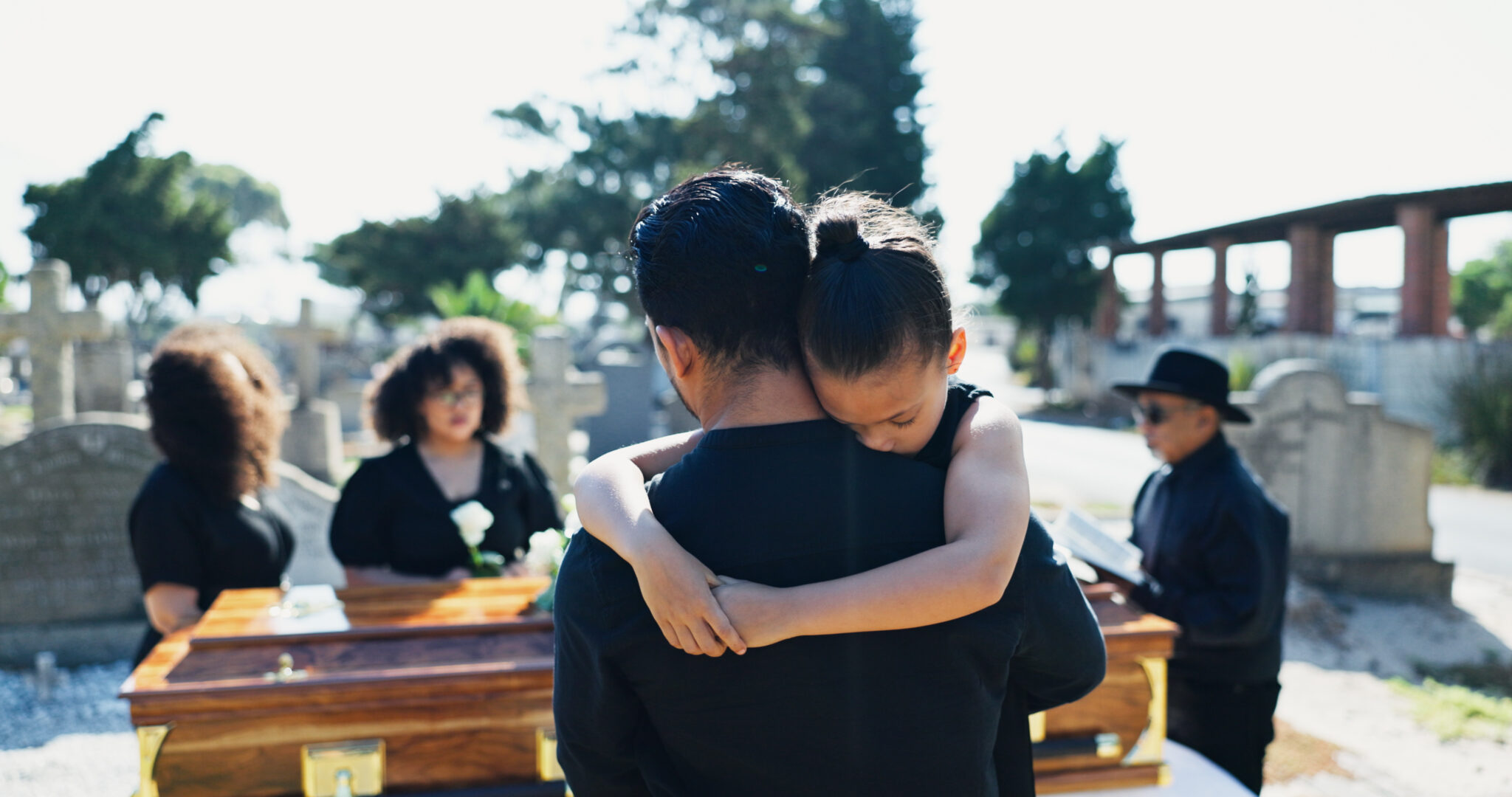
“If a child starts expressing fear about dying, the most important thing is to approach the conversation with openness and calm,” says Marti Munford, LPC, NCC with Anxiety Specialists of Atlanta. “It can be uncomfortable, but these moments are powerful opportunities to help kids make sense of big feelings and questions.” She suggests using questions to understand the child’s perspective. For example, “Can you tell me more about what you’re worried about?” This approach can help you understand whether your child is reacting to something specific, such as a tragedy, or wrestling with a broader fear.
As with other events in life, modeling healthy behaviors is critical for helping children grieve. “It’s OK to cry in front of your child and to say you’re sad,” says Hendricks. “And, reassure them that everything will be OK.” Being strong and not showing emotion can teach your child that she shouldn’t talk about her grief.
Also, your child should not be your primary support; be sure to find another adult to share your experience and feelings with. “Give yourself permission to take care of your own emotions,” says Munford. “Kids don’t need perfection, they need presence. When they see you calmly embracing difficult feelings and uncertainty, they learn that they can do the same.”
It is important to know that children often grieve differently than adults. “It presents more through behavior than emotional responses and words like in grown-ups,” says Hendricks. If you see regression — potty accidents, baby talk, not wanting to sleep alone — these are signs of grief in children. For older kids, it could be changes in diet or isolating behaviors.
If these behaviors start to interfere with day-to-day life, your child may need additional support. “For the first month or so, especially with the death of a close family member, these behaviors are normal,” says Hendricks. “But, if they continue, there can be cause for concern.” She recommends seeking group therapy, art therapy or play therapy for kids. Kate’s Club services are free and are a good resource for families experiencing loss.
“Kids experience grief in smaller doses, but over longer periods of time,” says Hendricks. “And, teens may test limits with higher risk behavior.” This is why it is critical to keep lines of communication open. Have calm conversations and ask open-ended questions. Reassure your child that everything will be OK in the long-term and that you and others love him.
Helpful At-Home Resources
When someone dies, it impacts everyone in the family. Here are some tools that can help open up conversations in a safe and supportive way.
 For Young Children:
Sesame Street Workshop Videos
When Dinosaurs Die by Laurie Krasny Brown and Marc Brown
Something Very Sad Happened by Bonnie Zucker
The Invisible String by Patrice Karst
For Older Kids:
What Happens When a Loved One Dies? by Dr. Jillian Roberts
There Are Two Kinds of Terrible by Peggy Mann
Lost in the Middle from New York Life Foundation
Give them a journal to write down their thoughts
Sources: Marti Munford and katesclub.org
– Tali Benjamin