
Fueling Passion and Creativity: The Impact of Arts Programs

Balanchine Stager Stacy Caddell with Atlanta Ballet Centre for Dance Education Academy Students. Choreography by George Balanchine © The George Balanchine Trust / Kim Kenney.
Atlanta is a center of activity for the beauty and excitement of the arts. The performing arts offer cognitive and physical benefits as children develop musical, motor, auditory and social skills.
“Dance involves the body fully, not just in physicality but also with memory,” says Sharon Story, Dean of Atlanta Ballet Centre for Dance Education. “It’s all encompassing. There are so many aspects between mind and body that all work together. Everybody’s body and mind are completely different, so dancers can succeed at their own pace.”
Because metro Atlanta is a hub for the arts, there are so many opportunities for children to learn and connect with others. “Music brings a community together. From an early music class to participating in a choir at a religious facility to a school band ensemble, you have a built-in group of people with a common interest,” says Sarah Grant, the Vice President of Education and Community Engagement at Atlanta Symphony Orchestra. “If our young people are looking for a place of belonging, music has that intrinsically.”
Students also learn to collaborate with their peers. “Students have the discipline to work together, and they have to make sure that camaraderie carries on and off stage,” Story says.
Children learn personal responsibility through performing arts. No matter their passion, they must develop discipline and time management to balance the expectations.

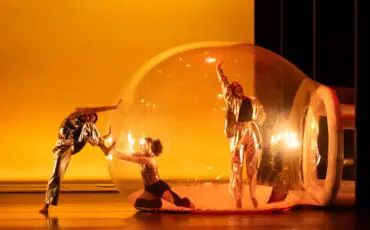
Palefsky Collision Project at Alliance Theatre, 2025 / Casey Ford
“Theater and rehearsal spaces are places where young people can rehearse reality,” says Samantha Provenzano, Alliance Theatre’s Teen Programs Manager. “They’re practicing living in community by being a part of an ensemble and paying attention to the room and to other people’s feelings and emotions. Theater also puts you in a pressure cooker of time, so you have to be your most creative and best self quickly.”
This feeling of community extends to the parents and families.
“It can be a barrier when parents don’t understand what that arts world is like. Jump in and try it. You’ll meet other parents who are figuring this out,” Grant says. “When they come together to support what their kids love, there is a learning community for parents as well.”
Students benefit from the practice of resilience. They learn what it means to fail and keep trying, and when they accomplish hard tasks, they know they have the ability to overcome difficulties in the future.
“You learn more from a negative experience,” says Dr. Gordon Vernick, Professor of Music and Coordinator of Jazz Studies at Georgia State University and founder of the Rialto Youth Jazz Orchestra. “You hear, ‘Practice makes perfect,’ but I’ve always hated that saying. If everything is perfect, it’s boring, and if everything is positive, you start to believe you’re infallible.”
The arts can connect students to different people, places and histories from around the world. “Music is the cultural fabric of our society. The arts reinforce that cultural fabric more than any other thing we could offer our children,” Vernick says.
Arts learning leads to a lifelong appreciation of the arts, whether it’s viewing an exhibit or going to a live performance.
“We need audiences,” Vernick says. “We need people who understand why music is important.”
In the metro area, there are many opportunities to start learning. Especially when your child is young and trying different activities, the first class may not be the best fit.
“Stay curious with your child,” Provenzano says. “If your student tries a class and it’s not right, keep trying. Enjoy the process together.”

Atlanta Symphony Youth Orchestra
Rising Stars: Programs for Talented Kids and Teens
If your child shows a passion for music, dance or theater that goes beyond a casual interest, you’re in a wonderful position to help that spark grow. Atlanta is home to several top-notch programs designed to nurture young artists and help transform early enthusiasm into real skill and confidence. If you have a rising star at home, now is the perfect time to encourage their abilities, support their creative journey, and watch their love for the arts and talent flourish.
For students interested in music, the Atlanta Symphony Orchestra offers rising 8th-12th graders the chance to audition for the Atlanta Symphony Youth Orchestra, while their Talent Development Program identifies and trains highly dedicated student musicians.
Students may also be interested in the Rialto Youth Jazz Orchestra, which consists of one big band and multiple jazz combos. Students receive instruction in jazz performance, jazz history and jazz improvisation with groups ranging from the intermediate to advanced level.
Atlanta Ballet Centre for Dance Education trains passionate dancers starting at age 9 in their Academy. With up to five hours of required daily classes, students practice classical and contemporary ballet, pointe, adagio, modern and jazz. Atlanta Ballet 2 is the Centre’s highest level of training and is the pathway to becoming an Atlanta Ballet Company member.
Teens with a love of theater can join the Alliance Theatre Teen Ensemble, an audition-based program for rising juniors and seniors. The Palefsky Collision Project is held in the summer, providing a whirlwind experience showcasing all the student’s theater education.
If your child is interested in diving in, be aware of the expectations of these programs.
Self-Motivation
Passionate students who want to work on their skills must have a level of excitement and dedication for their art, as well as the discipline and time management skills to keep up with their academic studies.
“We’re training students who have talent, passion and a love of practicing to help them become professional musicians,” Grant says. Learning teaches the lifelong value of dedication. Students must be able to motivate themselves. “My goal is to teach students how to get better on their own,” Vernick says. “You see LeBron James playing on the court, but you don’t see the 10,000 hours he spent practicing. I teach my students how to teach themselves.”
Arts programs require a time commitment to build on their skills. “A lot of folks who have not had access to arts or theater don’t understand the level of work in a production. It takes a full company to create the show,” Provenzano says. “Acting is one piece of the puzzle. There is work that goes into building your craft. It’s about the actors having full control over their body and voice, memorizing the entire play, learning blocking and bringing their acting technique to the stage.”

Rialto Youth Jazz Orchestra
Commitment
Beyond the student’s personal motivation, families will dedicate time and money to these passions.
This level of commitment involves the entire family. “Being a professional musician is a family affair,” Grant says. “There is time spent making sure they get to practice, rehearsals and summer camps. There are also financial resources. If you’re heading to Julliard for an audition, your cello needs an airplane seat as well.”
Communication is an important component between the student, the family and the program of interest.
“We make parents very aware this is a commitment, and we talk to the family,” Story says. For example, Academy Levels 1 and 2 students meet five days a week and must participate in the Spring Concert. “The commitment for these programs, from parents and family, helps to have these young dancers understand what it takes to become a professional or collegiate dancer.”
Engaging in theater requires dedication. “Rehearsals are five days a week. When there’s a professional commitment, actors are getting tutored at the theater or they’re homeschooled,” Provenzano says. “Rehearsals start after school or there are weekend classes, so it’s a 24/7 passion. There is some travel required if you’re trying to be at a certain level. Even if you’re new to it, you’re taking the kiddo to take weekend classes to dip their toe in.”
Collaboration
These programs also offer students the chance to connect with people they can look up to.
Students have access to ASO musicians and professionals as mentors. “It’s an easier path if you see someone you relate to doing the things you want to do. If you know and interact with that person, even better,” Grant says. “We have a huge network of alumni to help students, which opens the doors to networking and mentorship. Having access to other musicians can be a gamechanger.”
Dancers have the opportunity to be mentored by members of Atlanta Ballet, and they also serve as mentors for the younger students. “It’s their inspiration. They’re looking at dancers who have gone through the journey they aspire to,” Story says. “We have a variety of folks from the area and around the world, so they can relate to dancers who look, feel and act like them.”
Risk Taking
While auditions may be a fear-inducing prospect for students, they contribute to growth.
“We’re giving students the tools to successfully negotiate music,” Vernick says. “Auditions are as much about what the student can do as what the student can’t do. Auditions really teach humility, and they help you to focus your skills.”
Auditions are an opportunity for students to find the right place for them. “Auditions can help them learn where they are in their journey and what they need to work on,” Story says. “It also exposes you to the styles of the different schools. Yes, you’re auditioning for them, but you’re also auditioning them. It can relieve the nerves to know auditions go both ways.”
Once students reach a certain level, auditioning will be part of their norm. “For a lot of professional actors, most of the job is auditioning,” Provenzano says. “Especially for young people, auditions are a way to practice risk taking. There is no guarantee you’re going to get the thing. You have to prep for it. It’s a good way to practice hope.”